
The invoice is in ERP, the employee contract is in HR, and the project letter is in another system. Through the Mstnd API, you can sync documents and data across systems, then benefit from Mstnd's search, analysis, permissions, and archiving capabilities without repeated manual entry.
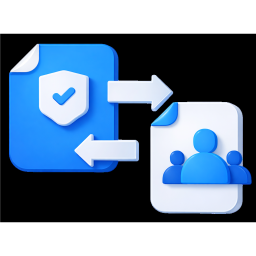
Mstnd integrates with enterprise systems via an API and dedicated connection keys. An external system can create a document, update its data, or sync a file and its fields, while Mstnd handles content management, search, permissions, and lifecycle. The integration scope is defined based on the system and the operations required.
An invoice is created in ERP, then an employee downloads it and uploads it manually to the document system and re-enters the supplier number, date, and value. If the data changes in the source system, the Mstnd copy stays outdated, and manual reconciliation between two systems begins.
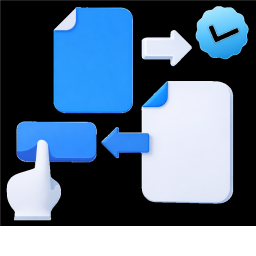
The API links the two systems so the document and its data move or update according to the agreed event. ERP stays responsible for the financial process, while Mstnd handles search, permissions, workflow, archiving, and analysis without re-entering the data.
Consistent data, fewer entry errors, and the benefit of Mstnd's capabilities without isolating existing enterprise systems.
An invoice may be issued from ERP and then downloaded manually by an employee into a folder, or an employee contract created in HR with another copy saved in email. With every manual step come the chances of forgetting, duplication, and differing data, and the team doesn't know which system holds the final copy.
Replacing every system isn't a logical solution. It's better for each system to play its role, with the document and required data moving in an organized and secure way.
A flow can be designed to send invoices, purchase orders, or contracts from ERP to Mstnd, along with their number, supplier data, amount, and date. The copy becomes searchable, archivable, and linkable to permissions and approval paths without manual re-uploading.
Employee contracts, letters, and job documents can be synced from the HR system to the employee's folder or the relevant department, and linked to expiry dates, reminders, and access policies.
Project platforms, CRM, or government and enterprise service systems can be connected depending on the availability of their interfaces and the project scope, to create or fetch documents or update their status and link them to the right record.
The integrations module provides management for API keys and documentation for developers. Each integration should be granted the least permissions it needs, its operations monitored, and its environment and system keys separated according to the organization's policy.
Yes. Mstnd provides a documented API and management for API keys to build integrations with other systems according to permissions and project scope.
Mstnd provides a library of pre-built connections and integrations, and custom integrations can be built with ERP and HR systems depending on the system in use, its interfaces, and the fields and operations required.
Yes, the integration can be designed to move the file and its associated fields such as number, date, party, status, and category, depending on what both interfaces support.
No. The operational system stays responsible for its core processes, while Mstnd adds a specialized layer for document management, search, permissions, workflow, and archiving.
By using separate keys, the least permission scope, encrypted communication, verifying every request, logging operations, and rotating keys according to the organization's security policy.
Don't move documents manually between systems.
Share your systems architecture and we'll define the right integration scope with Mstnd